

.png)
Executive Summary
Determining the optimum execution sequence across multiple active work fronts — while respecting a limited pool of delivery teams — is one of the most cognitively demanding tasks in construction planning. On a mega mining/processing project involving multiple contractors delivering under EPC construction arrangements, ECS applied ALICE, a generative scheduling platform, to this challenge. A sequencing exercise that would conventionally consume several hours to several days of expert planner time was resolved in under 20 minutes of the optimizer’s runtime, with the majority of the effort shifting upstream into structured model set-up rather than manual trial-and-error.
The Challenge
Complex construction programmes rarely fail for lack of a schedule — they struggle because the schedule embeds thousands of interacting sequencing decisions that no single planner can fully explore by hand. The project in question presented a familiar but stubborn problem: numerous concurrent work fronts competing for a finite number of delivery teams.
With teams constrained, the planner cannot simply run every work front in parallel. Instead, they must decide which fronts to prioritise, in what order, and how to handle crews between areas to minimise idle time and reduce overall duration. The number of feasible permutations grows exponentially with each additional work front and resource constraint.
Traditionally, a senior planner tackles this through iterative manual re-sequencing: adjusting logic, re-levelling resources, inspecting the resulting critical path, and repeating the process. Each cycle is slow, and only a small fraction of the possible solution space is ever examined. The outcome is a schedule that is defensible but rarely provably as optimal — and the process can absorb hours or days of scarce expert resources and time.
The Solution
The exercise followed a structured workflow. Notably, the analytical bottleneck moved away from computation and toward faithful model set-up — the stage where the planner's domain expertise is most valuable:
-
Schedule import: The existing project schedule was imported into ALICE, establishing the activities, durations, and baseline logic as the foundation for optimization.
-
Parameter modelling:
-
Resource allocation: delivery teams and crews were defined and assigned to the relevant activities and work fronts.
-
Soft-logic identification: the team distinguished true hard constraints from preferential (soft) logic — sequencing choices made by convention rather than physical necessity — and introduced these into the system so the solver was free to rearrange them.
-
Resource limits: upper and lower bounds on team availability were configured, encoding the core constraint that too few teams cannot serve every work front at once
-
-
Scenario generation and analysis:
-
With the model in place, ALICE generated and evaluated a large population of valid execution sequences, ranking them against the optimization objective.
-
The optimum sequence across the competing work fronts was identified in under 20 minutes of runtime — with the majority of total effort having been invested in the upstream set-up rather than the search itself.
-
Mahdi Goodarzi, Head of Project Controls Scheduling & Planning at ECS Associates said, "Before ALICE, sequencing a job like this meant days of trial and error: re-levelling resources by hand, checking the critical path, adjusting, and starting again. With ALICE, we could finally separate what was a true hard constraint from what was just how we'd always done it. ALICE surfaced optimal sequences we would have never landed on manually, while always respecting our client’s resourcing limitation. What used to be my most stressful task has become the part of the job where I get to use strategic thinking, instead of just grinding through rework."
The Results
The biggest outcome was a step-change in speed and rigour. A task that conventionally demands hours or days of manual iteration produced a solver-verified optimum sequence in less than 20 minutes. Beyond raw speed, three qualitative gains stood out for the ECS team:
- Breadth of exploration: thousands of sequencing scenarios were assessed automatically; versus the handful a planner can realistically test by hand.
- Constraint compliance: the 300-person resource ceiling was respected in every period, whereas the manual profile breached it in peak weeks (see Figure 1).
- Evidence-based confidence: the selected sequence was backed by systematic evaluation of the solution space rather than intuition, strengthening its defensibility to stakeholders.
- Higher-value use of expertise: planner effort was redirected from repetitive re-sequencing to model definition and interpretation — the judgement-rich activities where human insight adds most.
Resource Levelling Against the 300-Person Constraint
A defining constraint on the project was a hard ceiling of 300 personnel on site at any one time. The figure below contrasts the weekly resource histogram produced manually (top) with the profile generated by ALICE (bottom), with the 300-person threshold marked in red on both.
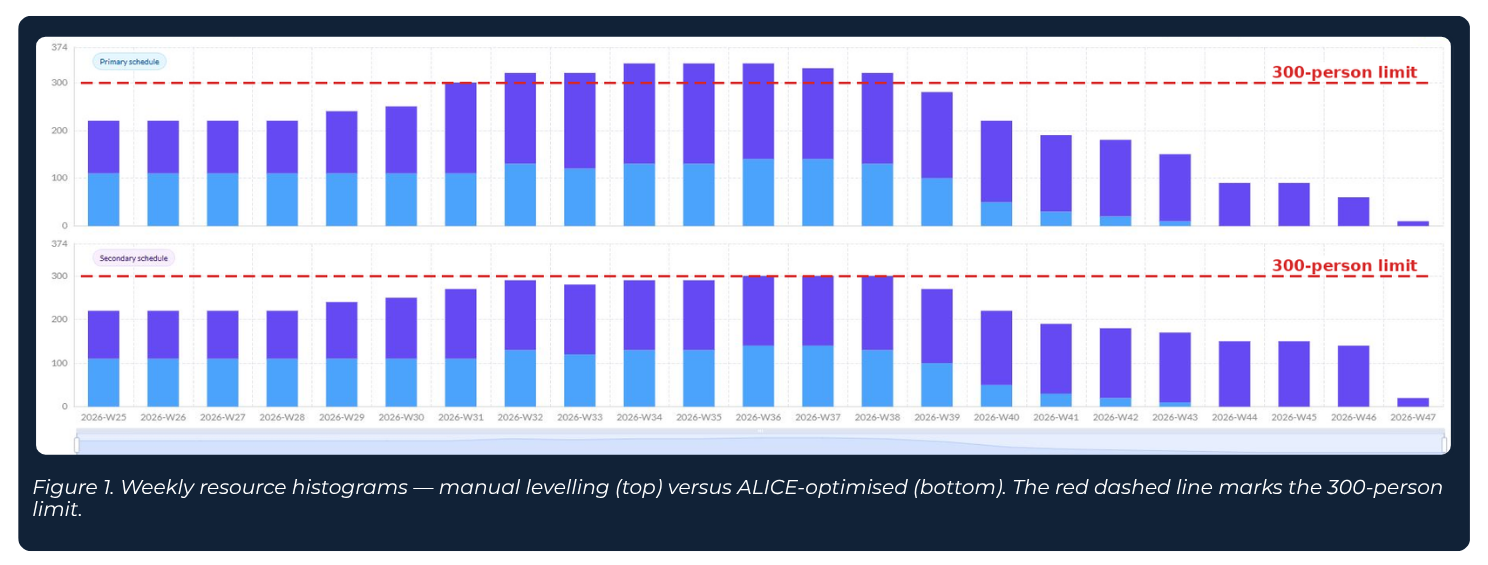
The manual profile breaches the 300-person limit across several peak weeks — an outcome that, in practice, means an unfeasible or non-compliant plan requiring further rework. Because that profile took four to five hours to build by hand, correcting the breaches or responding to a client's request for alternatives would have meant repeating much of that effort from scratch.
The ALICE-generated profile, by contrast, never exceeds the 300-person threshold in any period. The resource ceiling was encoded directly as a constraint, so every one of the thousands of scenarios the solver evaluated was compliant by construction. The entire exercise — constraint modelling and scenario running combined — took roughly 20 minutes and can be re-run against revised limits or client comments in a fraction of the original manual time.
-
Manual (top): peaks push above 300 in the busiest weeks — non-compliant, and expensive to correct.
-
ALICE (bottom): resource profile respects the 300-person ceiling throughout — compliant by design.
-
Adjustability: revised limits or alternative solutions are handled by re-running the model, not rebuilding the schedule — turning a multi-hour redo into a rapid iteration.
“Our job at ECS isn't just to hand clients a schedule, it's to give them confidence that the plan is the optimized one, not just the first one that worked. ALICE lets us do that. Turning a multi-day planning exercise into a 20-minute, real-time session means we can show up to client conversations with alternatives ready, not excuses for delays. That's the standard we want across every complex programme we undertake at ECS: sound, evidence-based, and adaptable, because on complex projects, conditions always change."
 Executive Director at ECS Associates
-1.png)
Metrics that matter
See how ALICE helps the largest GCs and Owners increase their project margins and mitigate risks.