Overview
Every construction team has sat through some version of the same meeting. The monthly update comes in, the dashboard says the project is three weeks behind, and someone asks the question nobody wants to answer: can we trust that number?
The honest answer is usually "it depends on the schedule." The forecast, the variance report, the S-curve and the recovery plan are all calculated from the same file. If that file has missing logic, soft and hard constraints pinning dates in place, or durations that hide slow progress, every number downstream inherits the problem. No amount of analytics fixes that after the fact.
That is what our product manager, Nate Pummel, termed as "the ceiling effect" of a construction schedule.
It is essentially defined as the upper limit set by your schedule quality on how accurate, and how useful, everything built on top of it can be.
What is schedule quality?
Schedule quality is a measure of whether a construction schedule is built well enough to model the project it describes. A high-quality schedule has complete logic, realistic durations, sensible float and very few artificial date constraints. When something changes on site, a well-built construction schedule moves the way the real project would.
Most of the industry measures this against the DCMA 14-point assessment, a set of checks developed by the US Defense Contract Management Agency. The checks look for issues such as:
- Activities missing a predecessor or successor
- Leads, excessive lags and hard constraints
- High float, negative float and long durations
- Invalid dates and a critical path that fails basic tests
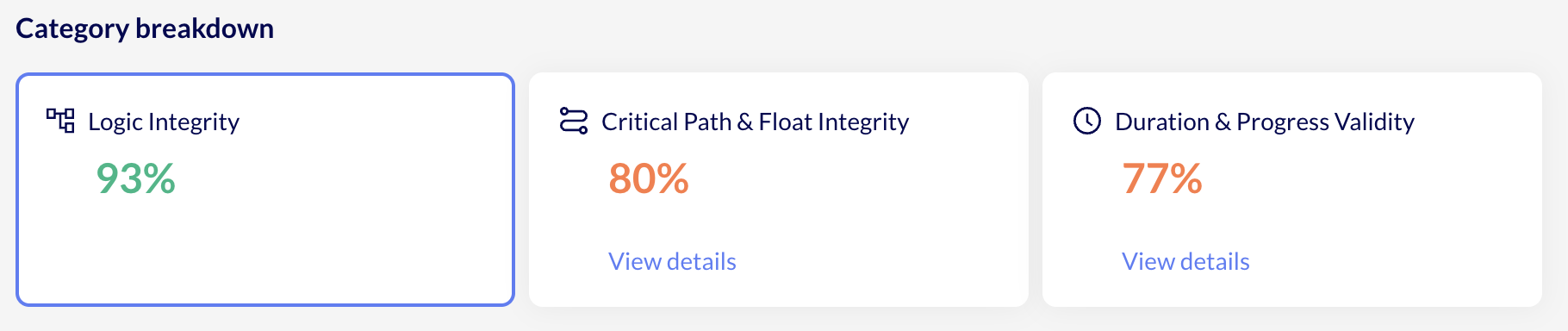
ALICE Technologies' Schedule Quality feature automatically runs a schedule through 13 metrics rooted in DCMA-14 and returns a weighted 0 to 100 score. It also sorts every issue into Critical, Warning or Improvement, so teams know what to fix first.
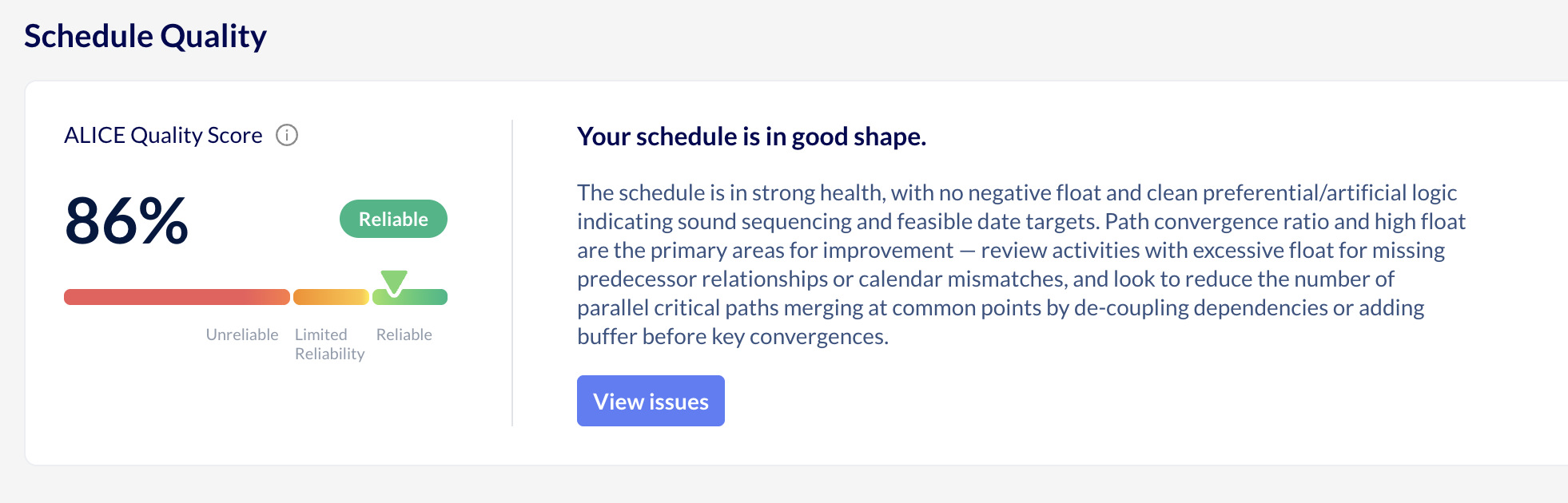
One point is worth stating plainly: A schedule can look complete and still score poorly. Every activity can have a date while the file fails as a model, because constraints are holding those dates in place instead of logic driving them.
Why is a construction project's schedule quality important?
Schedule quality matters because the schedule is more than a plan. It is the input to almost every decision made during execution. Owners use it to judge whether a project is on track. Contractors use it to support time extensions and defend against delay claims. Project controls teams report progress from it, and executives use it to decide which projects need attention.
When quality is low, the damage usually stays hidden until late in the job:
- Missing logic. A delay on one activity doesn't push its successors, so the critical path looks shorter and float looks healthier than it really is.
- Hard constraints. The finish date stays wherever someone pinned it, regardless of progress. The schedule says on time while the jobsite says otherwise.
- Long durations. Activities that span months make progress hard to measure. Forty percent complete on a 120-day activity tells you very little.
- Negative float. The schedule already can't meet its commitments, and nothing else in the monthly report reflects it.
None of these issues show up as a red flag on a progress chart. They show up as a forecast that looked fine for six months and then suddenly didn't.
How schedule quality sets the limit for everything on your project
Think of the schedule as a project's digital foundation. With every report, forecast and optimization as a floor built on top of it. You can keep adding floors but at some point, you really can't build higher than the foundation will carry.
Here is how that plays out across a typical project analytics stack.
Progress measurement
Percent complete only means something if the activities being measured reflect the actual work. ALICE calculates planned progress from a baseline S-curve weighted to planned labor hours. If durations or resource loading are unrealistic, that curve is wrong before the first update arrives, and every comparison against it carries the same error.
Forecasting
A forecast finish date projects the remaining work based on how fast the team has actually been building, following the shape of the remaining baseline. If the remaining logic is incomplete, the forecast is extrapolating across a network that doesn't connect.
Critical path and float
Critical path analysis depends on logic. Open ends and constraints that override logic produce a critical path that reflects how the file was built, not how the job will run. Float trends calculated from that path mislead in the same direction.
Optimization and recovery
This is where "the ceiling effect" matters most. Exploring acceleration or recovery scenarios, resequencing work or testing crew changes and calendars all rely on the schedule's logic to know what can move and what can't. A weak schedule hands an optimizer false positive constraints in some places and negative freedom in others.
How to raise the ceiling to a high-quality schedule
The practical takeaway is simple: treat schedule quality as the first check, not an afterthought.
- Score the baseline before you approve it. Every variance you report for the rest of the project is measured against it. Fixing logic now costs far less than explaining a bad forecast later.
- Re-check every update. Quality drifts. Constraints get added to hold a date, and logic gets removed to make a sequence work. A schedule that scored well in month one may not in month six.
- Fix in priority order. Start with the issues that distort the whole network, like missing logic, hard constraints and negative float, before moving to smaller improvements.
- Read every downstream number with the score in mind. A forecast from a schedule scoring 90 deserves more weight than one from a schedule scoring 60.
ALICE's analytics and reporting features are built around this sequence. Schedule Quality scores the file and gives a prioritized fix list. Project Performance tracks progress and forecast finish against a baseline you can trust. When a project needs to get back on track, ALICE Optimize works from the same schedule, so the recovery plan rests on the same foundation as the analysis.
"Can we trust this number?" deserves a better answer than "it depends." Start with the schedule, and everything built on it gets more reliable.